Conference Speakers

Anastasia Suboch
Doc Health Metrics: How Two Writers Built a Framework to Prioritize Docs Across Dozens of Products
At Booking.com's FinTech division, two technical writers serve dozens of products. We needed a way to identify documentation priorities at scale and communicate the severity of docs issues in terms that product owners would act on. Without data, "the docs need work" was always deprioritized.
So we built a documentation health framework from our experience as technical writers, defining what makes docs healthy, measuring it with AI-powered instrumentation, and presenting findings in ways that actually prompt teams to improve. The framework measures five dimensions (coverage, readability, style compliance, freshness, and discoverability), produces reports with business impact mapping and tailored recommendations, and evolves after each assessment as we learn what works and what doesn't.
The talk is structured around three pillars, each with practical lessons for anyone trying to make documentation measurable and improvable:
- Defining metrics and instruments
- Getting input from stakeholders
- Presenting findings to stakeholders

Tal Gluck
Proving and improving the value of your docs
Most documentation teams believe their work is valuable. Few can prove it - and even fewer are sure they're measuring the right things. During research for the 2025 and 2026 State of Docs reports, this gap between perceived value and demonstrated value was one of the most consistent pain points across teams of every size and maturity level.
This talk offers some practical ways to start making sense of docs metrics, whether you're tracking nothing yet or you've got data and aren't quite sure what to do with it.
We'll look at why the metrics that help you make a case to leadership can be different from the metrics that help you improve the actual quality of your docs, and why mixing them up leads to frustration on both fronts. We'll talk about why point-in-time numbers tell you less than you'd hope, and what to look at instead. And we'll look at some newer signals - search queries, AI conversation patterns - that can surface gaps your traffic data will never show you.
No single system works for everyone, but by the end you'll have a clearer sense of what you can measure based on your actual goals and concrete things you can try.

Kel Raleigh
Beyond Automation: Human Judgment as the Strategic Core of Business Writing
AI can write. But it can’t decide what matters.
As AI tools rapidly transform how we produce content, business writing is shifting from a craft of creation to a discipline of judgment. Drafting, summarizing, and even structuring ideas are increasingly automated, but knowing what to say, how to frame it, and why it matters still belongs to humans. This session introduces the Judgment Over Generation Model, a practical way to think about modern writing as a three-layer system: AI-enabled generation, human-AI interpretation, and human-led judgment. While AI accelerates the bottom layers, value and risk live at the top.
We’ll explore what “judgment” actually looks like in real-world writing. Drawing on examples from high-stakes environments like proposals and executive communication, this session shows how over-reliance on AI can lead to generic, misaligned, or even misleading content, and how intentional human input turns that same content into something effective.
Whether you’re a technical writer, content designer, or documentation lead, this session offers a way to rethink your role in an AI-enabled workflow. You’ll leave with a clear framework for where AI helps, where it doesn’t, and how to strengthen the one skill that’s becoming more valuable, not less: judgment.

Jen Buley
Structure after the fact: Bringing content strategy to existing docs for a design system
Good information buried in poor structure is still poor documentation. When I joined our design system team as their first and only "content person," the docs were already substantial — hundreds of pages created by knowledgeable, dedicated subject matter experts, but with no one owning the whole.
The value didn't shine through. Outdated content lurked beside fresh content. Hedging language made best practices sound like mere options. And a jumbled architecture left users wondering where to begin and whether they'd found everything.
Everyone had a theory about what to fix first. Engineers wanted me to correct specific pages and fill gaps. Designers wanted outreach and advocacy. Both priorities mattered, but without a sound content strategy and structure, neither would improve the docs experience for our users. And as one content expert to around 60 developers and designers, I knew my efforts had to scale.
Adding to the challenge, I started without a technical background. But this forced me to see the tangle differently and to ask basic questions about why our docs didn’t work better for users or contributors.
In this talk, I'll share how to diagnose problems and get buy-in for more strategic efforts, and how to use "just enough" content strategy and design (low-effort research, contributor-centric tools, and strategic collaboration) to make content changes with impact. I'll show you how we improved navigation, information value, and how we work, and I'll be honest about what was harder than expected and what I'd do differently.

Uladzislava Lahun
Silence Is Not Approval: When Better Docs Create More Feedback
When our product and user base were smaller, documentation feedback was easy to ignore — or at least easy to handle informally. Developers spoke directly with key users, documentation was often treated as a historical record of features, and the only regular “metric” we had was the last update date.
Then the product grew. The documentation grew. User expectations grew even faster to soon reach its lowest point. As the documentation couldn’t deliver users stopped taking it seriously (and stopped giving a sincere feedback)
As a small documentation team responsible for a large internal knowledge base, we needed more than occasional complaints in Slack, scattered tickets, and second-hand feedback from managers. We needed to understand what users actually needed, prioritize competing requests, and show the impact of documentation work without turning feedback collection into a full-time research project.
In this talk, I’ll share how we moved from sporadic feedback to a lightweight feedback loop built around annual surveys, shorter tracking surveys, focused interviews, onboarding feedback, and temporary focus groups. I’ll talk about what worked, what did not, and why some of our most useful signals were not higher satisfaction scores, but more specific complaints, higher expectations, and increased user involvement.
Attendees will leave with a practical model for building a documentation feedback loop in a small team including:
- how to choose between surveys, interviews, focus groups, and support signals;
- how to turn vague complaints into actionable documentation tasks; and
- how to use feedback not only to measure documentation quality, but to build a stronger community around the docs.

Kate Wilcox
Moonshot mindset: A tech writer's guide to thinking big and breaking free from the GDZ
Have you ever felt like you were stuck in a "good-dog zone” (GDZ) as a tech writer? Stakeholders toss you a content request, and you race to complete it as fast as you can, time after time. It can feel exhilarating, even rewarding. But it can also limit your creativity, stifle career growth, and lead to burnout.
One way to break free from the GDZ is to adopt a moonshot mindset. Moonshots are ambitious projects designed to address challenging issues. When you have a moonshot mindset, you’re not satisfied with the status quo and incremental gains. You take a wider, more proactive view, looking for innovative solutions and exponential progress.
Launching moonshots, however, can be daunting and risky. Success isn’t guaranteed, and you still have to complete those ongoing content requests. Where do you find the time to innovate?
This talk explains how to develop a moonshot mindset while managing ongoing work and minimizing risk. Using real-world examples, it demonstrates how to pivot from being a reactive service provider to a proactive strategist. And it shows that when tech writers think big, they don’t just document the product, they improve it.

Oishi Banerjee
When words become attacks: prompt injection through a technical writing lens
Every documentation team writes content that flows into AI systems from API examples, error messages, support instructions, and onboarding guides. Most teams optimise for clarity and user understanding. Few consider documentation as a potential attack surface.
Prompt injection is the practice of embedding instructions in text that cause AI systems to override intended behaviour. Documentation, by nature, is text that AI systems read, process, and act on. What appears harmless to human readers can function as a directive to a model.
This talk reframes a security concern as a writing craft concern for technical writers. Through three real documentation patterns for instance, an API usage example, an error recovery instruction, and a support script. My intention is to make the audience identify how specific language choices create unintended ambiguity for AI systems. We then apply writing principles, covering instruction separation, context containment, and explicit scope framing to demonstrate how the same content can be rewritten for both human clarity and AI safety.
The goal is not to transform technical writers into security engineers, but to expand what constitutes as an AI safe documentation. When words are read by machines as much as by humans, my talk proves that writers already possess the skills to contribute to AI safety, governance, and trust.

Elena Baskakova
Good Enough at Scale: Documentation Infrastructure Under Capacity Constraints
In many companies, product complexity grows faster than documentation capacity. More products, APIs, SDKs, releases, and integrations appear, while dedicated documentation capacity stays flat, grows more slowly, or is reduced.
“Perfect documentation everywhere” was never realistic. But when product complexity grows faster than documentation capacity, the trade-offs become sharper: what must be excellent, what can be good enough, and which gaps need to be visible?
This talk is about building documentation infrastructure in that situation. I will talk about GitHub workflows, AI-assisted drafting, automated checks, stale-content detection, review gates, migration from fragmented tools, and explicit tracking of documentation coverage gaps.
The main lesson is that automation does not remove documentation work. It moves part of the work into infrastructure. Every prompt, workflow, check, integration, and AI-assisted process needs ownership and maintenance. If we ignore this, the docs infrastructure becomes another source of debt.
This is not a talk about replacing technical writers with AI. It is about using AI and automation carefully, while accepting that the realistic goal is often good-enough documentation: critical paths are reliable, gaps are visible, risks are clear, and limited human capacity is used where it matters most.

Alexandra Klepper
Write inclusive, people-first language about AI
There's a trending inclination towards "building accessibility for AI," promoting accessibility as a need for machines and humans. On its face, it may seem like a win-win: people with disabilities benefit from further investment into building accessible applications. Especially as agents' access to documentation has grown and agents rely on the accessibility tree to understand web pages, it's critical we remember who accessibility is for.
As defined by W3C's Web Accessibility Initiative, accessibility is a practice for humans. AI just happens to benefit from this work. At the risk of alienating PMs and engineers who are newly enthusiastic about building accessible software, we must write our content and build our software prioritizing human needs above machine needs. The people most likely to be left behind in the shift to AI are people with disabilities.
As more companies mandate the usage of AI, both as a feature in their products and a tool employees must use, shifting towards inclusive language can lead to more inclusive work by the individual contributors who are building the final products. Perhaps it also offers an opportunity for a greater narrative shift.
In this talk, I share guidelines for writing inclusive content that reflects the purpose of accessibility and the needs of AI.

Stephan Rayner
Trading in Trust: How Documentation Protects People, Not Just Projects
Documentation isn't simply a reference artifact, it's trust infrastructure. Its job isn't only to inform, but also to create and preserve the conditions under which people can work together honestly. Without it, power fills the vacuum, and the loudest voice wins.
This talk tells two stories from opposite ends of the same dynamic:
- As head of data at a toxic and now defunct mobile games company, my junior analysts were regularly pressured into handing over data to stakeholders who then misused it.
- I'm the arrogant Senior Machine Learning Engineer who lost an argument to a well-written expense policy.
Both stories reveal the same mechanism: good documentation externalizes authority, leveling a playing field decided by power, clout, or seniority, and doing it without so many difficult conversations.
You'll leave with a practical framework for writing docs that do this work:
- Write for the enforcer, not just the reader: think about who has to hold the line when someone pushes back
- Document the why alongside the what: rules without reasoning invite argument
- Anchor to mission rather than procedure: clear purpose lets people reason from it themselves, rather than needing every edge case spelled out
- Make your limitations visible: a doc that names what it doesn't cover builds more trust than one that oversells

Whitney Burkes
Writing Less, Owning More: The Shift in Technical Writing
Documentation teams are increasingly being asked to scale their output using AI tools, but often without established practices to guide them. The use of AI tools looks promising, but often lead to inconsistent documentation, ad-hoc prompt usage, and uneven results across teams.
This talk shares how our team approached that challenge by focusing on process, not tools. We began treating prompts like a new kind of documentation asset: curated, versioned, and reviewed, much like code. By grounding prompts directly in the codebase and managing them as a shared resource, we created a system capable of generating consistent, usable first drafts at scale and essentially created living documentation.
Through a practical case study developed at Deutsche Bank, I’ll share how we built a scalable prompt repository, introduced a review workflow, and turned individual experimentation into a repeatable team practice.
From this talk, you will learn:
- How to structure and manage a shared prompt repository
- How to introduce lightweight review workflows for generated content
- How to scale documentation practices across teams
- How to maintain quality when documentation is generated at scale
- How the role of technical writers is shifting from writing to shaping and guiding content

Javier Rubio
Documenting APIs: new era, same craft
With an API, no marketing claim holds up: its quality is measured by the quality of its documentation.
Documentation is not an afterthought; it's the API's interface to the world. In this talk, we'll look at what makes API documentation actually useful, starting with the essentials:
- The main technical standards and why they matter: OpenAPI, its extensions, and the Arazzo workflow spec.
- How to explain the key conventions that the standards don't cover: authentication, errors, pagination, rate limiting, versioning.
- Writing guides and tutorials with a product lens, for different user profiles: from someone who just needs a working example to someone who wants to understand the full design.
- The state of the ecosystem for documenting your API and building your developer portal.
- How to build shared ownership in your team and push a culture of treating docs as a living product
Finally, we'll take a look at what has changed for API documentarians in the AI age, and what hasn't.
Useful both for people starting out with API docs and for those who want to professionalise a practice that often stays overlooked.
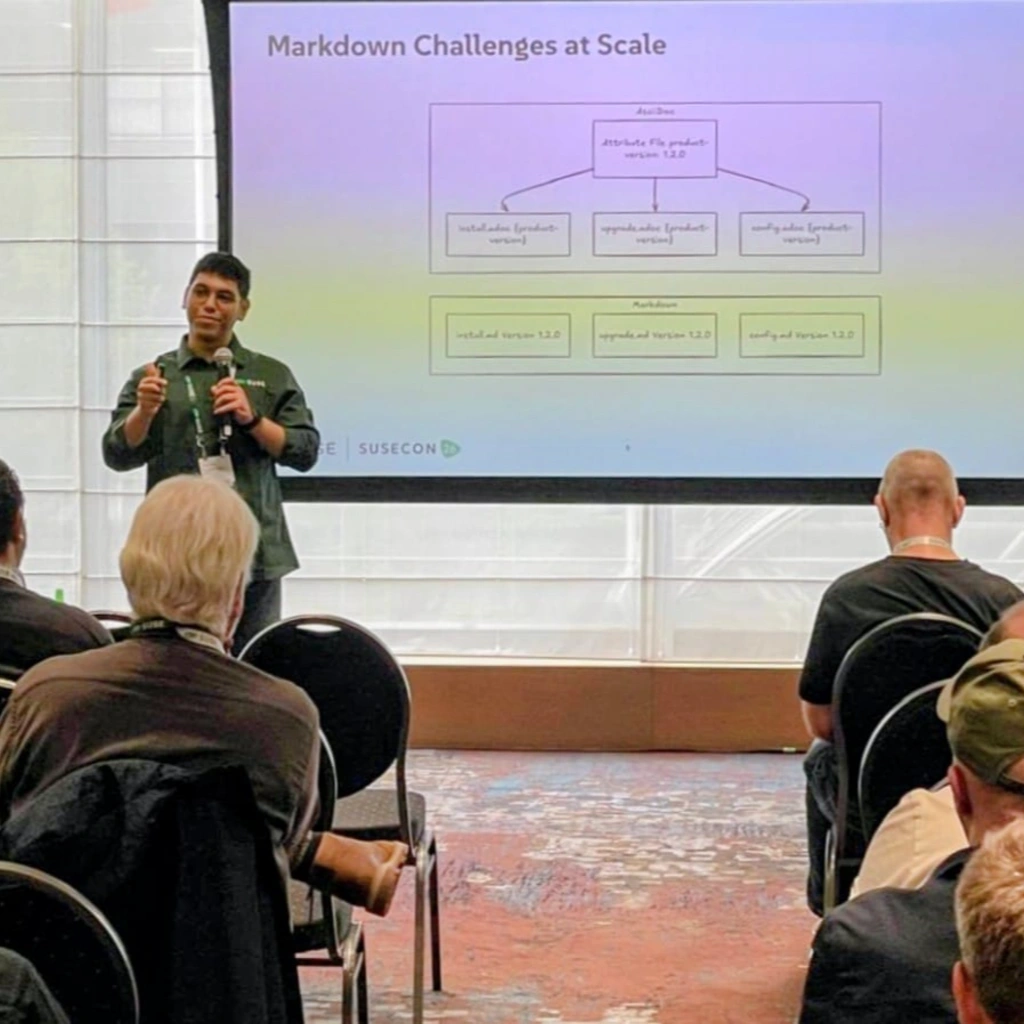
Hridyesh Bisht
Mapping Your Docs-as-Code Repository: Navigating the Architectural Evolution of Repositories
Choosing a repository architecture for a modern docs-as-code workspace is rarely an easy decision. As an organisation scales, managing where content lives becomes a balancing act between data security, localisation, and avoiding manual duplication.
Engineers want documentation embedded directly inside their specific code repositories for autonomy, but writing teams need central oversight to maintain quality. This tension between data security boundaries, multi-repository isolation, and the fundamental need for a uniform customer-facing portal is one of the most painful, hidden infrastructure bottlenecks in documentation architecture.
This talk focuses on a case study of how a documentation team mapped out, tested, and deployed advanced repository layouts to survive rapid company growth. Inspired by large-scale open-source documentation structures, this session breaks down the real-world benefits, maintenance downsides, and exact technical logic behind four core architecture patterns:
- The Public-Private Mirror
- Multi-Branch Single-Sourcing
- File-System Symlinks
- Shared Git Subdirectories